
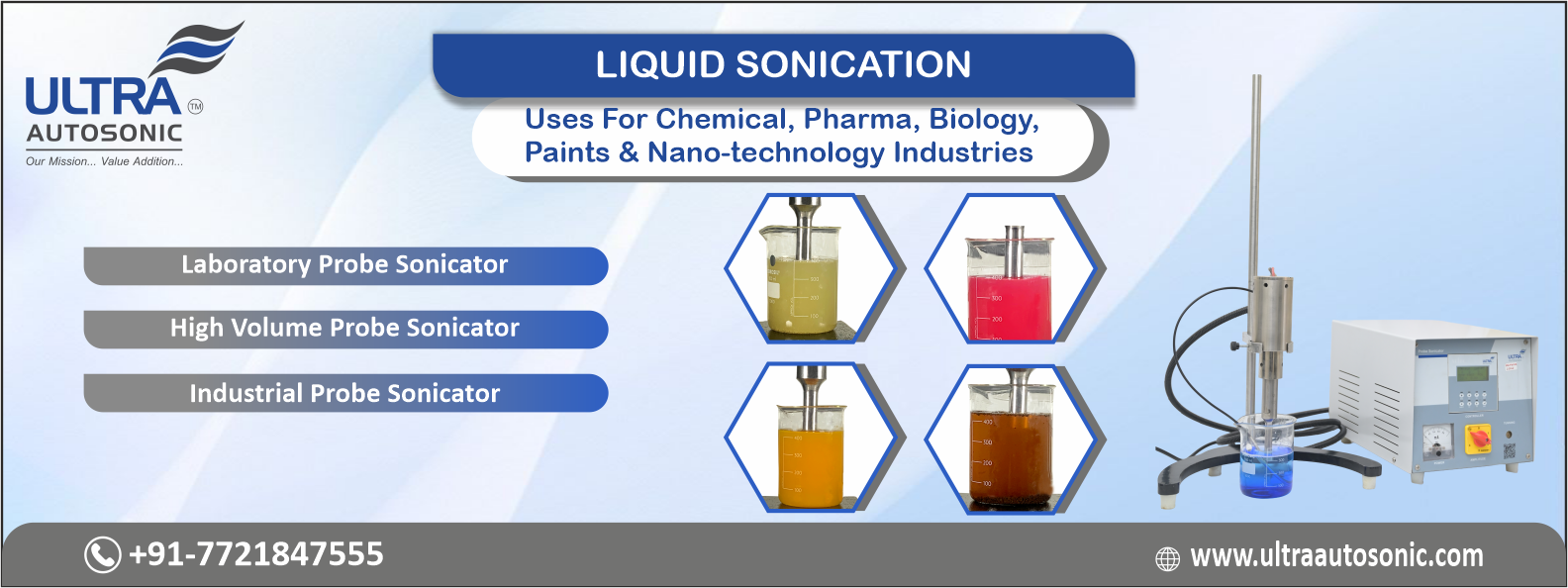
Liquid Sonication is a process in which high-frequency ultrasonic waves are applied to a liquid to create cavitation-microscopic bubbles that rapidly collapse resulting in intense energy that helps mix, disperse, emulsify or break down substances within the liquid.
✅ Applications After Sonication:
Cell & Tissue preparation for histology
Nanoparticle dispersion
DNA/RNA extraction
Emulsification
Homogenization
Deagglomeration
Cell Disruption & Lysis
Sample Preparation for analysis
Sonochemistry
✅ We proudly meet and exceed market demands with innovative solutions tailored to your needs!
Efficient mixing and homogenization, particle size reduction, catalyst activation, and wastewater treatment are key processes in chemical industrial operations.
Nanoformulations and drug delivery, cell disruption for drug development, sterile processing and emulsification, and quality control and standardization are essential aspects of pharmaceutical manufacturing.
Nanoparticle synthesis and functionalization, dispersion of carbon nanotubes and graphene, liposome and micelle formation, and sonochemical reactions are critical processes in the nanotechnology industry.
Cell lysis and DNA/RNA extraction, protein and enzyme processing, bacterial and yeast disruption, and biofuel production are essential processes in the biotechnology industry.
Oil-water emulsification, desulfurization and refining, asphaltene and paraffin breakdown, and enhanced oil recovery (EOR) are crucial processes in the oil industry.
Pigment dispersion and stabilization, particle size reduction, formulation of high-performance coatings, and improving shelf life and stability are essential processes in the paints and coatings industry.
Extraction of bioactive compounds, accelerated aging of spirits, fermentation enhancement, and homogenization and quality control are key processes in the distillery industry.
Efficient mixing and homogenization, particle size reduction, catalyst activation, and wastewater treatment are key processes in chemical industrial operations.
Nanoformulations and drug delivery, cell disruption for drug development, sterile processing and emulsification, and quality control and standardization are essential aspects of pharmaceutical manufacturing.
Nanoparticle synthesis and functionalization, dispersion of carbon nanotubes and graphene, liposome and micelle formation, and sonochemical reactions are critical processes in the nanotechnology industry.
Cell lysis and DNA/RNA extraction, protein and enzyme processing, bacterial and yeast disruption, and biofuel production are essential processes in the biotechnology industry.
Oil-water emulsification, desulfurization and refining, asphaltene and paraffin breakdown, and enhanced oil recovery (EOR) are crucial processes in the oil industry.
Pigment dispersion and stabilization, particle size reduction, formulation of high-performance coatings, and improving shelf life and stability are essential processes in the paints and coatings industry.
Extraction of bioactive compounds, accelerated aging of spirits, fermentation enhancement, and homogenization and quality control are key processes in the distillery industry.